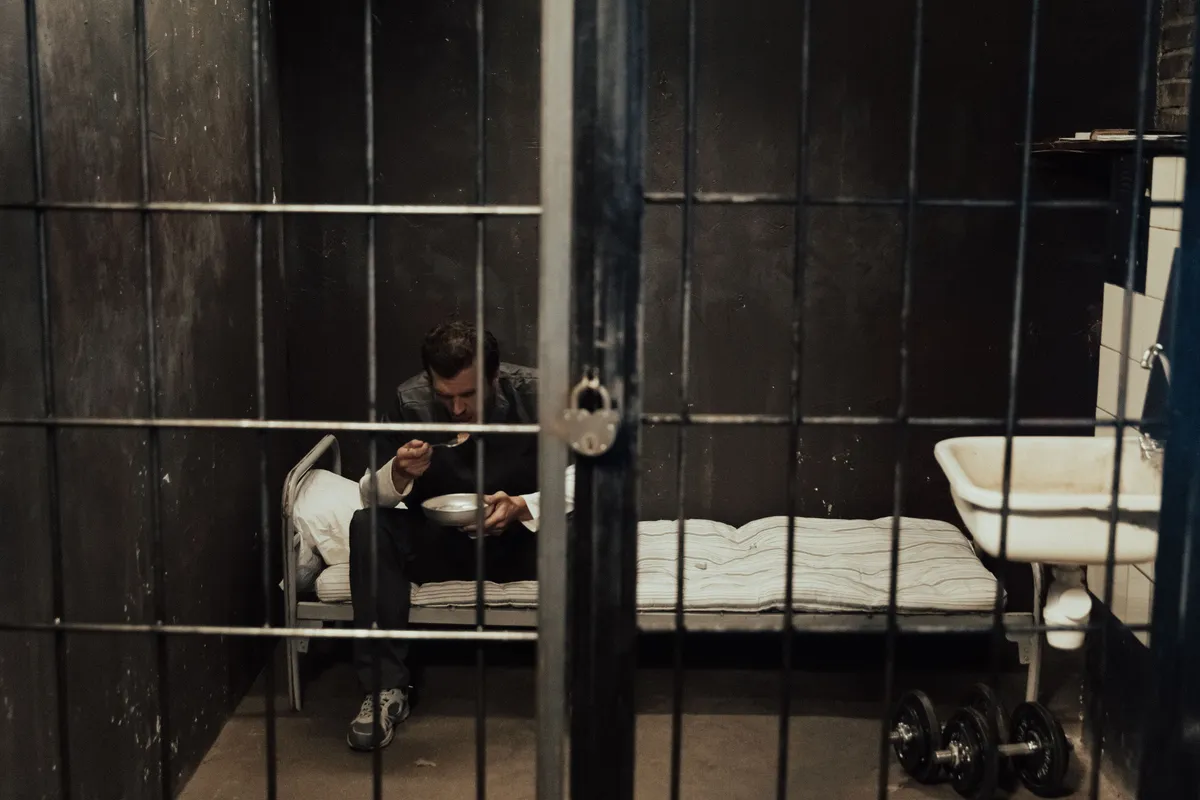
grade 9 news paper article death penalty
GCSE English: Why Understanding Different Viewpoints Gets Top Grades
If you want your child to succeed in English, there is one skill that matters more than almost any other: the ability to understand different points of view.
It sits at the heart of Language and Literature. It also matters in Business Studies, Geography, History and Religious Studies, to name just a few. And it is a genuine life skill. Imagine what opens up for your child when they can listen, empathise and understand someone's perspective, even when they don't share it.
So how do you actually build it?
To be frank, the only way is through discussion, debate and listening to others.
Think about the news. Take the Christa Pike case in the USA. It has sparked debate over capital punishment for young offenders, and it is a serious, sensitive topic with strong views on every side: justice for the victim, the age of the offender, and the morality of the death penalty itself.
A child who can explore a topic like this from several angles, calmly and respectfully, can join global conversations with confidence instead of repeating one side of the story. That is what English is really about.
The proof: a Grade 9 student's article
One of our GCSE English students wrote an outstanding article on exactly this kind of topic. They went on to achieve a Grade 9. Here is what made it so effective.
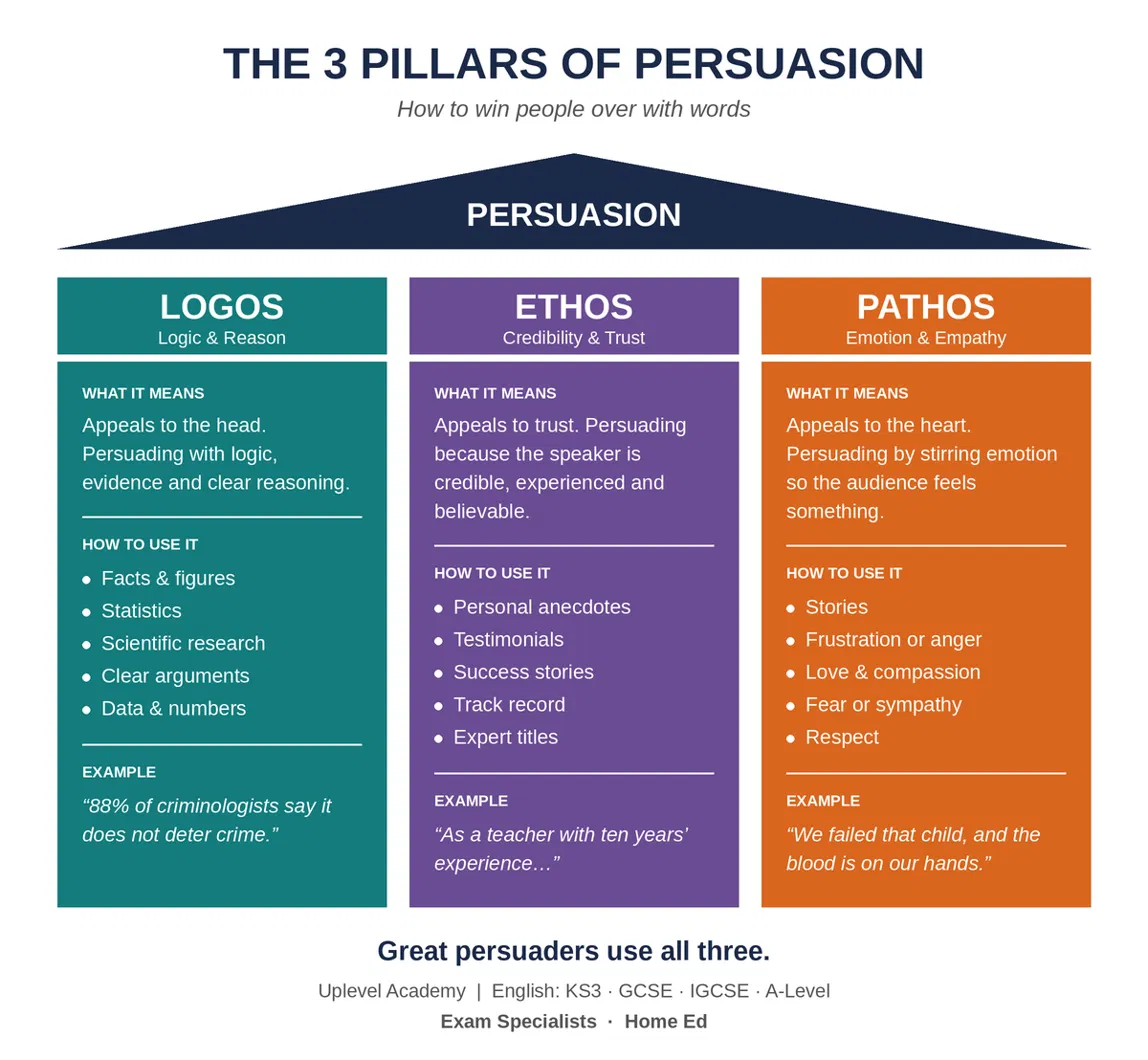
Logos: logic and evidence
It opens with a striking statistic: 88% of criminologists say the death penalty does little to deter violent crime.
It backs the argument with outside evidence, including studies from the Justice Department and 41 independent reviews of one case.
It builds a clear chain of reasoning: if we understand why crimes happen, we can prevent them.
It answers the cost argument with a real example, Curtis Carroll, whose prison education programme helps others stay out of crime.
Ethos: credibility and trust
Named cases, dates and official sources show the writer has done their research.
The writer stays fair. They say "no one is justifying her actions" and accept that victims' families want justice, so even a reader who disagrees can trust them.
Phrases like "we as a society" and "as a civilised person" invite the reader to share the writer's values.
Pathos: emotion
Strong, emotive words such as "heinous", "abominable" and "nightmarish" set the tone.
The story of a child abused from birth makes the reader feel the argument, and "the blood on her hands is on our hands" stirs guilt.
It describes how victims' families often feel afterwards, then ends hopefully with "We need more people like Curtis."
Other techniques that impact the reader
Anahora (repetition at the start of sentences) for impact: "No one cared. No one cared to listen to the facts."
Rhetorical questions that make the reader think: "But, was this really justice?"
Direct address in the ending: "Ask yourself…", which helps turn the 'passive' reader into someone 'active' who takes action.
That balance of evidence, emotion and fairness is exactly what examiners reward.
Read the full Grade 9 student article
Death to the Death Penalty: it has no place in the 21st Century!
A staggering 88% of criminologists believe that the death penalty does very little to deter criminals from committing heinous crimes, such as rape and murder. It therefore begs the question: why do modern, civilised countries still use it?
The area where this is most sensitive is when it comes to justice for victims and their families. In the past, there was a tendency to neglect the feelings of the victim; however, fortunately, this has changed. But how does murdering the person who has committed a crime help the victim? Quite often, it may make the victim feel better, but it is just a quick fix, and they then feel depressed, lost and sometimes even remorse and guilt at the murder of another human being, according to recent studies from the Justice Department.
So, how can we be sure that victims, and their families, receive justice? Instead of taking the myopic approach of utilising archaic justice methods, we should look for the reasons why homicides and rape occur. This does not mean that we look to excuse; or justify such abhorrent crimes; it means that we look for the reasons, so that we can prevent these terrible crimes from taking place.
The need for prevention is perhaps best encapsulated by the sordid case of Lisa Montgomery. Papers and news outlets were quick to brandish Montgomery as the living embodiment of pure evil for her ‘wicked act’ of strangling and murdering a pregnant woman and then cutting the baby from its dying mother. And, because of the victim’s family demanding justice by murdering the murderer, it seemed that justice was taking place by sentencing Montgomery to death, which was carried out in January 2021. But, was this really justice? How come 41 independent reviews of the case stated that Montgomery herself was a victim? No one cared. No one cared to listen to the facts. The facts were: Montgomery was tortured from birth. She was raped and beaten, so much so that she was left with a brain injury, rendering her psychotic at the time of her disturbing actions. Again, no one is justifying her actions. However, rather than taking the easy way out and blaming it solely on Montgomery, we should look at the failings of society. We allowed a system to keep horrible humans in prisons. Despite the obvious callousness in this thinking, this does not consider the fact that people serving life sentences can become valuable members of society behind bars.
Curtis “Wall Street” Carroll is a perfect example of this. Sentenced to 54 years to life for his role in a robbery, in which one of his friends shot and killed a person, he took advantage of the educational opportunities in prison. This has allowed him to look at the reasons why people commit crimes - poor financial literacy. He himself was no stranger to poverty. Born to a ‘crackhead’ mother, he was left to fend for himself from a tender age. Being black and dyslexic also meant that he faced huge challenges at school; he was neglected by teachers and so didn’t like attending. But in prison, with nothing else to do, he studied. Using what he had learnt for the greater good, he helped set up ‘ProjectFEEL’ to help educate other inmates, so that when they were released, they would not fall into the same old habits, and they would be ‘money smart’, so they would not commit crimes out of desperation. If he were put to death, we would not have tax-saving educational programmes, like ‘ProjectFeel’, to prevent people from reoffending. We need more people like Curtis.
So, the next time you read about a horrific crime. Ask yourself: as a civilised person, living in the 21st C, what caused this person to commit such an abominable act? What could we as a society have done better? And, what can I do, the next time I have the chance to protest about death penalties in other countries, to help prevent such tragedies from occurring, so that I do not have to read sensationalised stories that are writtenjust to sell newspapers?
Why a group works better than one-to-one
I know some parents think, "My child needs one-to-one." With respect, they need the tools to engage in a group, because that is what will enrich their life. One-to-one limits children: they can't access the range of perspectives that English demands, and they can't fully develop their own ideas without feedback from others.
In Uplevel Academy's English programmes, your child will:
Become part of a group where they are valued and heard
Express their opinions and listen to others
Gain an advantage over their peers by discussing key topics with children from all walks of life
Do it all from the comfort of their own home
And if you want to find out about the real cost of tuition - click here to read our blog.
Ready to give your child this skill?
If you want your child to build this life skill and achieve the grades that come with it, get in touch today.
Want more tips?
Click here to go to our blog: how to structure a newspaper article - transactional writing


